Hungary takes cake seriously. Very seriously. Serious enough that every year, a jury of pastry professionals tastes its way through dozens of creations to answer one extremely important national question:
What should Hungary taste like this year?
The result is the Magyarország Tortája – the Cake of Hungary.
And no, this isn’t just a cute title invented by a Budapest café to sell tourists an expensive slice of dessert. It’s a real national competition connected to Hungary’s biggest national holiday, August 20, and in 2026 it celebrated its 20th edition.
This year also broke a record: Hungarian pastry chefs entered 60 different cakes into the competition. Sixty. Imagine being on that jury.
Actually, don’t. By cake number 37, even we would probably start questioning our life choices.
But the winner has now been crowned, and if you’re visiting Hungary this year, there’s a good chance you’ll spot it behind the glass counters of pastry shops around the country.
Here’s what you need to know before ordering a slice.
Wait. Hungary has an official cake?
Basically, yes. Every year, the Hungarian Confectioners’ Guild (Magyar Cukrász Ipartestület) organises the Cake of Hungary competition to celebrate August 20, one of Hungary’s most important national holidays.
August 20 commemorates Saint Stephen, Hungary’s first king and the foundation of the Hungarian state. Think fireworks over the Danube, flags everywhere, concerts, festivals, enormous crowds around Parliament – and, apparently, cake. Lots of cake.
The idea is that Hungary gets a new symbolic birthday cake every year.
Pastry chefs from around the country compete to create something that feels unmistakably Hungarian while still pushing modern Hungarian pastry forward.
And over the past two decades, this has become much bigger than a niche competition for pastry professionals. When the winner is announced, it becomes national news.
People debate it. People queue for it. People complain about the price of a slice. People argue that the cake from three years ago was better.
In other words: Hungary treats it exactly like you’d expect Hungary to treat a national institution.
The 20th competition was different
For the anniversary edition in 2026, the organisers introduced a theme that sounds incredibly ordinary until you realise how Hungarian it actually is:
rögös túró and sour cream.
If you're unfamiliar with túró, welcome to one of the great Hungarian food translation problems.
Calling it simply “cottage cheese” isn't quite right. Calling it curd cheese gets closer. But rögös túró has its own characteristic crumbly texture and is deeply embedded in Hungarian cooking.
We put túró in pasta. We put it in dumplings. We put it inside chocolate bars. We turn it into desserts. We eat it sweet. We eat it savoury.
At some point, you'll realise Hungarians will basically put túró anywhere if given the opportunity.
Rögös túró has been part of Hungarian cuisine for centuries and even holds EU Traditional Speciality Guaranteed status.
So for the 20th Cake of Hungary, pastry chefs were challenged to take two deeply familiar ingredients – Hungarian rögös túró and sour cream – and transform them into something worthy of a modern pastry shop.
The important part?
The cake still had to taste like them.
This wasn't a competition to hide a spoonful of sour cream underneath half a kilo of chocolate and technically tick the box. Other ingredients could support the flavours, but the Hungarian dairy products had to remain part of the cake's identity.
And apparently Hungarian pastry chefs had plenty of ideas.
A record 60 cakes entered the competition, so many that two separate semi-finals had to be organised.
For the first time, the competition also crossed Hungary's present-day borders, with an entry arriving from Székely Land in Transylvania.
Not bad for a birthday cake.
And the winner is… Bíborfehér
After multiple rounds of judging, the 2026 Cake of Hungary title went to Bíborfehér, created by pastry chefs László Balogh, Zoltán Balogh and Kis Roland from Kézműves Cukrászda in Gyula.
And this is where things get interesting.
Because if your mental image of Hungarian dessert is something extremely sweet, extremely heavy and possibly containing enough walnuts to survive a Central European winter, Bíborfehér might surprise you.
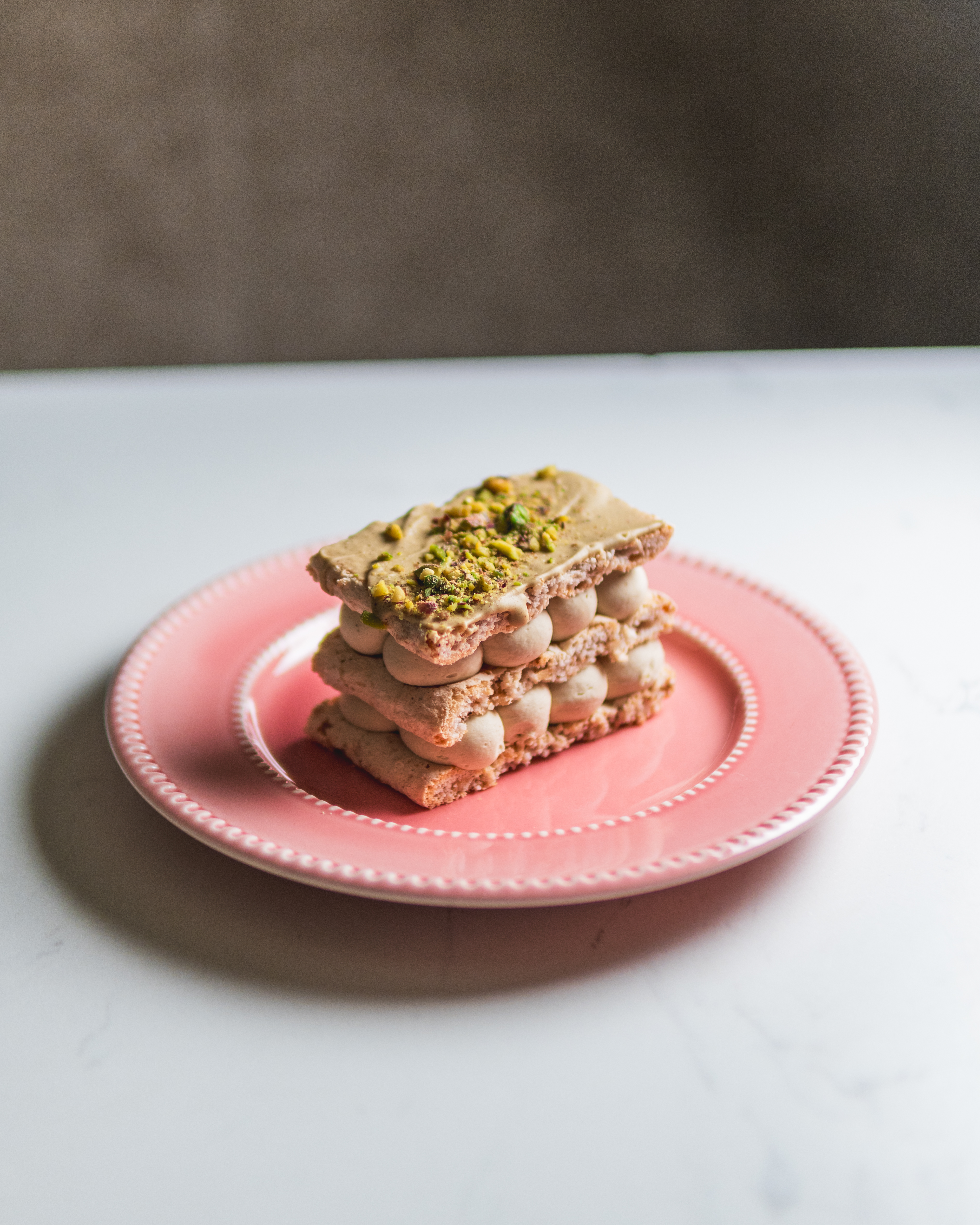
The winning cake combines rögös túró and sour cream mousse with forest berries, blackcurrant wine, roasted almonds, chocolate, vanilla and lemon.
So instead of trying to reinvent Hungarian cuisine into something unrecognisable, it does something much smarter.
It takes flavours Hungarians already understand and gives them a modern pastry-shop upgrade.
Creamy. Fruity. Slightly tart. Nutty. Fresh. And very Hungarian without screaming:
LOOK, WE PUT PAPRIKA IN A CAKE. For which we should all be grateful.
What does “Bíborfehér” mean?
Literally, something close to “crimson and white.”
And once you know what's inside the cake, the name makes sense.
The deep purple-red tones of the forest fruits contrast with the pale túró and sour cream elements – a fairly elegant visual summary of the dessert itself.
But there's another reason the combination works so well.
Hungarian desserts have a long love affair with tart fruits: sour cherries, plums, currants, apricots and berries regularly appear alongside creamy, nutty or dough-based elements.
Bíborfehér feels modern, but the flavour logic behind it is very familiar.
That's arguably what the Cake of Hungary competition does best when it works: not turning Hungarian food into a museum piece, but showing how traditional ingredients can evolve.
So where can you actually eat it?
This is the useful part. The Cake of Hungary isn't created just for the jury and then locked away in a pastry vault somewhere under Budapest.
From August 20, participating pastry shops around Hungary can sell the official cake.
That means if you're travelling through Budapest – or elsewhere in Hungary – during late summer or autumn, look for “Magyarország Tortája 2026” or simply the name “Bíborfehér” at pastry shops.
And don't assume you need to find some ultra-modern Michelin-adjacent dessert bar to try it.
One of the best things about the tradition is that participating cukrászdák are spread around the country. Which brings us to an important Hungarian cultural lesson.
Learn the word “cukrászda”
You need this word. Cukrászda. Roughly: pastry shop or confectionery. But culturally, it's more than that.
Hungary has a serious cukrászda tradition. These are places where you go specifically for cakes, pastries, coffee and the occasional moment of complete disregard for nutritional responsibility.
Some are elegant and historic.
Some are tiny neighbourhood institutions that look like they haven't changed since your Hungarian grandmother was young. Some are modern. Some have interiors that could generously be described as “1997”. Do not judge the cake by the furniture.
A proper Hungarian pastry crawl can be every bit as interesting as doing the ruin bars – just with significantly better decisions the following morning.
There’s also a sugar-free Cake of Hungary
Because apparently one national cake isn't enough.
Hungary also runs a separate Sugar-Free Cake of Hungary competition.
The 2026 winner is called Szilvafácska, created by Promenád Kávéház in Balatongyörök.
Its flavour world revolves around another ingredient Hungary understands extremely well:
plum.
Paired with cinnamon and other complementary flavours, it's a completely separate creation rather than simply a diet version of Bíborfehér.
So if you're travelling with someone who wants the official Cake of Hungary and someone else wants the sugar-free winner, congratulations.
You now have an excellent excuse to order both.
For research purposes, obviously.
Why should tourists care?
Because this is exactly the kind of thing that makes travelling interesting.
You can eat goulash anywhere that has a laminated menu and the words “traditional Hungarian” written in six languages.
But the Cake of Hungary is different. It's temporary. It changes every year. It tells you something about what Hungarian pastry chefs are experimenting with right now.
And there's something wonderfully strange about walking into a random neighbourhood pastry shop and ordering the same cake that people are eating hundreds of kilometres away because, for one year, the entire country collectively decided:
Yep. This is our cake. So while you're in Budapest, have your chimney cake. Try Dobos. Order Somlói. Find out whether you love or hate túrógombóc.
But save room for one slice of Bíborfehér. Because you can visit Hungary again next year.
But Hungary will already have a different birthday cake.